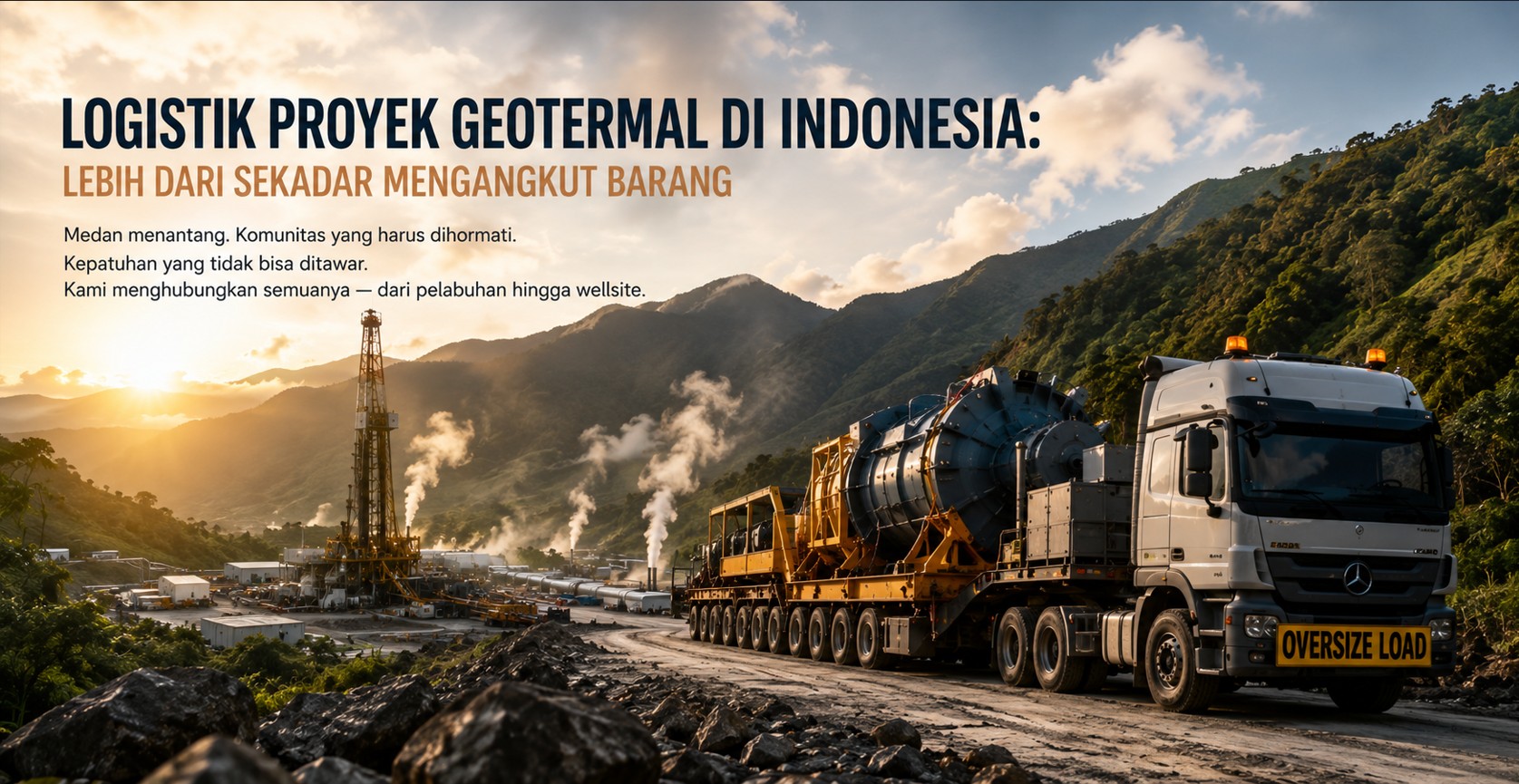
Geothermal Project Logistics in Indonesia:
More Than Just Moving Cargo
Indonesia holds the world’s largest geothermal potential. Yet behind this ambitious vision lies a logistics challenge that is rarely discussed—and often underestimated.
In 2026, the Indonesian government through Danantara has allocated USD 120 million for 19 new geothermal projects. Equipment will be imported. Drilling rigs will be mobilized. Heavy wellhead and casing components will be transported to project sites.
The question is no longer simply who transports the cargo—but who can truly ensure that all equipment arrives safely at the wellsite.
At PT Transcon Indonesia, we understand that the answer is never simple.
Not Just Remote Locations — But Mountainous Terrain
Most of Indonesia’s geothermal resources are located in volcanic mountain regions, often at elevations exceeding 1,000 meters above sea level. These are not merely remote areas—they represent terrain fundamentally different from conventional logistics projects.
Access roads to wellsites are rarely designed for heavy loads. Before any cargo moves, logistics teams must conduct comprehensive route surveys covering:
- bridge load limits
- minimum turning radii
- road gradients suitable for multi-axle vehicles
- surface conditions, particularly during the rainy season
Drilling rig components such as mud pumps and drawworks can weigh 30–35 tons per unit. Heavy casing arrives in long and oversized dimensions. All of this requires vehicles and cranes with minimum 50-ton capacity, along with detailed convoy planning before the first wheel turns.
A mistake in route surveying does not merely cause delay. It can damage local infrastructure, compromise safety, and potentially halt the entire project.
Local Community Coordination: A Core Risk Management Component
Every geothermal project in Indonesia passes through communities. Heavy equipment convoys often intersect with village roads, agricultural land, or areas with social and cultural significance.
A mismanaged approach here can delay projects longer than technical obstacles.
Engagement with community leaders, transparency in delivery schedules, and commitment to minimizing disruption are not merely ethical considerations—they are essential components of project risk management.
Experienced geothermal logistics teams understand that social license and communication are integral to execution.
Customs Compliance: A Non-Negotiable Competency
Many geothermal projects encounter avoidable delays at the customs level.
Drilling equipment, casing, wellhead components, and project spare parts are typically classified as imported capital goods. Each shipment requires:
- A complete and accurate Masterlist prior to project commencement
- Correct HS (Harmonized System) classification
- End-use declarations aligned with energy sector customs facilities
- Parallel documentation coordination among importer, shipping line, and Customs
This is not the work of a general freight forwarder. It requires a team experienced in capital goods import regulations for the energy sector, accustomed to operating within inflexible project timelines.
A single error in Masterlist submission or HS classification can hold equipment at port for weeks. In project logistics, time is a measurable cost.
Integrated Solutions, Not Just Transportation
Geothermal project logistics differ from standard cargo shipment because terrain, community coordination, and customs compliance must be resolved simultaneously—and in the correct sequence.
- Route surveys must be completed before shipment.
- Community coordination must precede convoy movement.
- Customs documentation must be finalized before cargo arrival.
PT Transcon Indonesia approaches geothermal projects as an integrated supply chain—from port to wellsite. Not merely transporting cargo, but ensuring that every stage is completed on schedule and in full regulatory compliance.
Indonesia Needs a Prepared Supply Chain
Indonesia’s geothermal project pipeline for 2026 and beyond represents a significant opportunity for renewable energy development. However, projects that appear solid on paper can stall in the field if logistics are not engineered with the necessary expertise.
For companies planning geothermal equipment mobilization—or evaluating logistics and customs readiness—strategic preparation from the outset becomes a decisive factor for success.