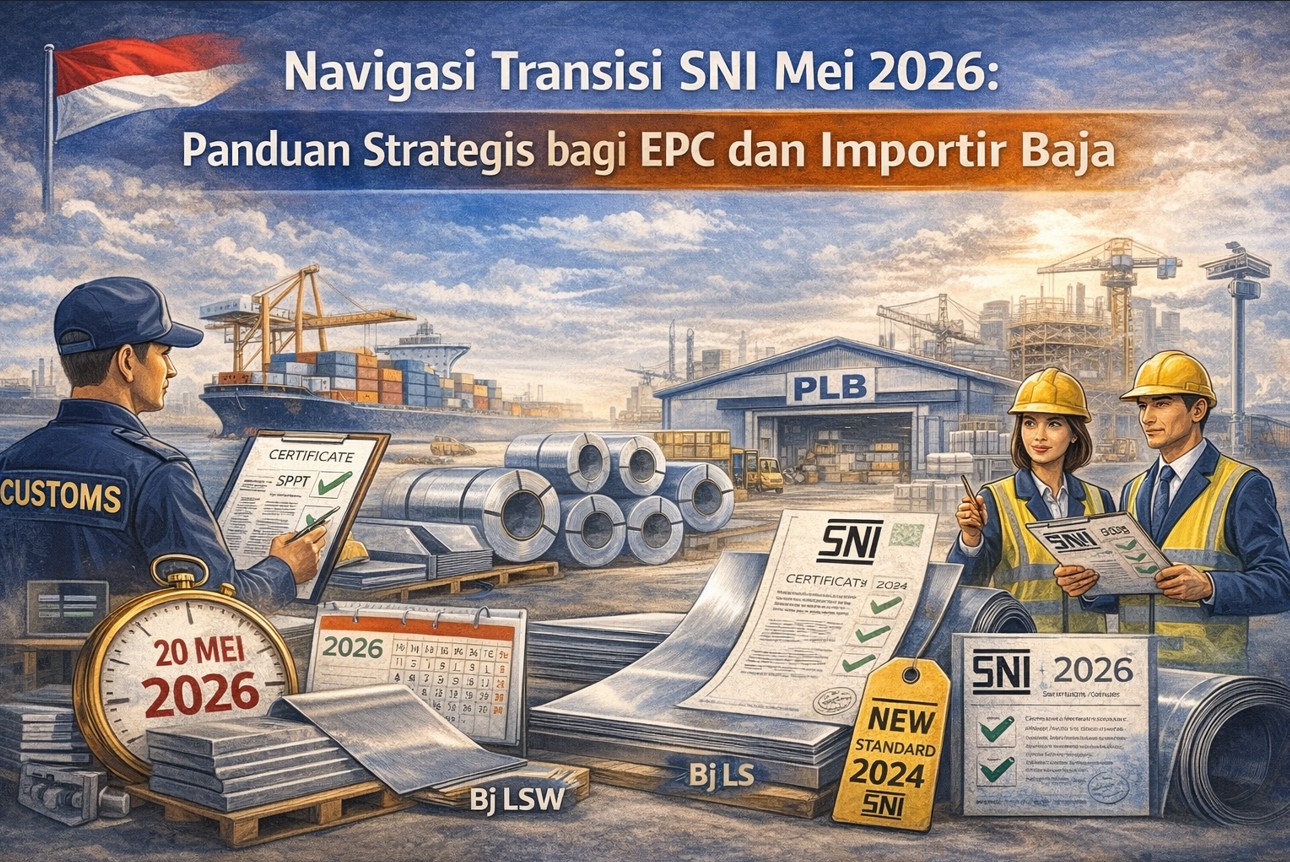
Navigating the May 2026 SNI Transition: A Strategic Imperative for EPC and Steel Importers
Indonesia is entering a decisive phase in strengthening national industrial standards. Through Ministerial Regulation (Permenperin) No. 23 of 2025, the government has introduced updated requirements for galvanized steel sheets (Bj LS) and aluminum-zinc coated steel sheets (Bj LSW).
This regulatory shift is not merely administrative. It reflects a broader industrial policy aimed at reinforcing infrastructure safety, ensuring product consistency, and elevating domestic quality benchmarks.
For Engineering, Procurement, and Construction (EPC) companies and steel importers, the implications are substantial. Compliance can no longer be treated as a downstream administrative checkpoint. It must be embedded into technical design, procurement planning, and import scheduling from the outset.
The Critical Timeline: May 20, 2026
The government has granted a transition period to allow industry adjustment. However, the deadline is firm.
As of May 20, 2026, all relevant steel products must comply with the 2024 SNI standards to be eligible for customs clearance.
This means:
-
Certificates issued under older standards (e.g., 2012 references) will become invalid.
-
Shipments arriving after the deadline without updated certification may face clearance rejection.
-
Project timelines could be directly impacted if transition planning is delayed.
Technical Shift: What Has Changed?
The transition from the 2012 to the 2024 standards introduces more advanced testing protocols and tighter quality parameters, particularly in:
-
Coating mass verification
-
Mechanical properties
-
Durability performance
-
Factory consistency validation
SNI 2053:2024 (Bj LS)
Applies to galvanized steel sheets.
Foreign manufacturers must prepare for updated factory audits and sampling procedures conducted under revised LSPro protocols.
SNI 66:2024 (Bj LSW)
Applies to aluminum-zinc coated steel sheets.
Emphasizes long-term corrosion resistance and performance in infrastructure applications.
For EPC firms, this requires early alignment between engineering specifications and the updated national standards. Delayed alignment may result in redesign costs or procurement adjustments mid-project.
Risk Exposure If Not Managed Early
Failure to transition strategically may lead to:
-
Customs clearance delays
-
Re-export or re-certification costs
-
Storage and demurrage accumulation
-
Pertek (Technical Consideration) revision
-
Disruption of EPC installation schedules
This is no longer simply a compliance issue. It is a project governance issue.
Immediate Action Checklist
To secure 2026 project continuity, companies should:
-
Audit Active Certificates
Identify SPPT SNI documents referencing older standards and prioritize renewal. -
Coordinate Early with Certification Bodies (LSPro)
Schedule factory audits and lab testing at least 12 months before the deadline to avoid bottlenecks. -
Update Technical Consideration (Pertek)
Ensure import volume allocations and HS codes reflect the updated SNI references in SIINas. -
Verify INSW Integration
Confirm updated certificates are properly synced with Indonesia National Single Window to maintain green lane clearance eligibility. -
Align with Logistics Strategy
Consider structured customs facilities (such as bonded solutions) to provide administrative flexibility during transition.
Strategic Perspective for Leadership
This regulatory shift should not be viewed as a constraint. It represents:
-
A reinforcement of quality standards
-
A filter against substandard materials
-
A competitive differentiator for compliant EPC players
Companies that integrate compliance into project design and procurement strategy today will gain operational certainty tomorrow.
The key question for leadership is no longer:
“Can we import this steel?”
But rather:
“Have we engineered this project to remain compliant through 2026 and beyond?”