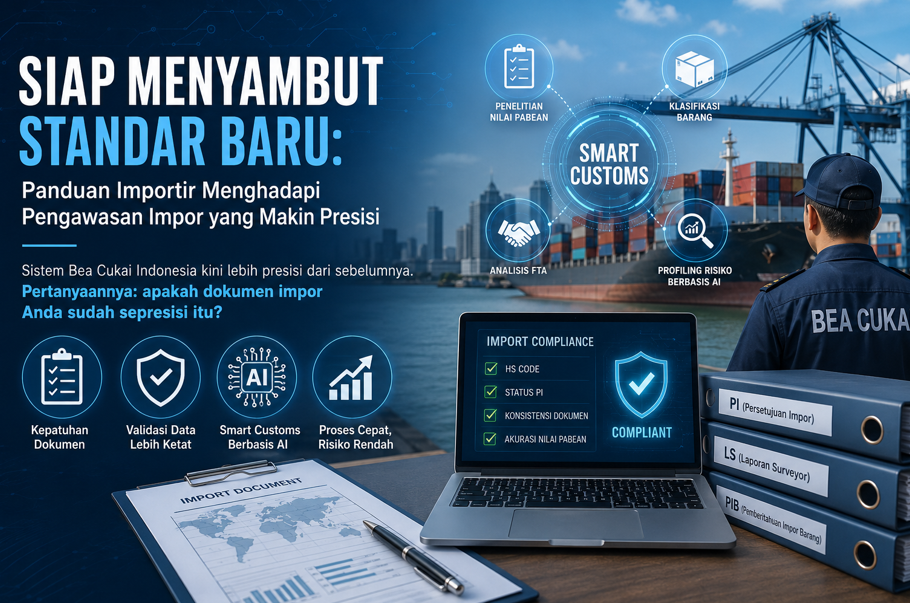
Ready for New Standards: An Importer's Guide to Increasingly Precise Import Controls
Indonesia's Customs System is now more precise than ever. The question is: are your import documents equally precise?
The year 2026 marks a significant step forward in national customs administration. The Directorate General of Customs and Excise (DJBC) is developing AI-based Smart Customs — technology that supports customs valuation research, goods classification, and analysis of free trade agreement (FTA) utilization in ways that are faster, more accurate, and more objective. Supported by optimized scanning equipment and AI-based risk profiling, this system is designed to make customs procedures more efficient for well-organized businesses while strengthening the transparency of national trade overall.
This is good news. For importers who have been running their processes meticulously, a more precise system means faster processing and greater predictability. However, this transformation also means that every documentation detail is now subject to a higher level of scrutiny.
Why This Matters Now
In line with this transformation, two policies that have been in effect throughout 2026 are now entering full implementation:
Permendag No. 18 Year 2026
strengthens data validation between Import Approval (PI), Surveyor Reports (LS), and customs documents (PIB), and clarifies compliance with import realization reporting. For importers managing multiple PIs simultaneously, data consistency in each submission is now key to maintaining the smooth flow of the entire company import portfolio.
Permendag No. 47 Year 2025
on goods prohibited from import has been in effect since the beginning of the year, providing clear certainty about product categories that require special attention — from strategic food commodities to products with specific material content.
These two policies, combined with AI-based oversight systems, create a more transparent and reliable customs ecosystem for businesses prepared to adapt.
Importer Readiness Checklist
Before this new system becomes fully mature, each importer should conduct a self-check:
- HS Code — Have you re-verified your product classification against the latest list of prohibited and restricted goods?
- PI Status — Is the import realization reporting for each active PI being monitored and submitted on time?
- Document Consistency — Are the PI numbers on your Surveyor Reports and PIB submissions aligned in each filing?
- Customs Valuation Accuracy — Is your goods valuation documentation complete and fully defensible?
Who Needs to Pay Attention
This system refinement is most relevant for:
- Industrial and manufacturing raw material importers who routinely manage Import Approvals and Surveyor Reports
- Distributors of chemicals, electronics, and medical equipment — sectors with complex HS Code classifications
- Companies with multiple PIs active simultaneously, who benefit most from organized monitoring systems
- Businesses operating from bonded zones and integrated logistics centers, which depend on smooth goods flow in line with production and distribution schedules
Compliance as an Advantage, Not a Burden
A more precise oversight system is actually an opportunity for businesses ready to adapt. With proper document management, importers can enjoy faster processing, greater predictability, and lower risk — while contributing to an increasingly transparent national trading ecosystem.
As a bonded logistics and customs partner, TCI helps clients ensure this readiness comprehensively — from auditing active PI status, verifying document consistency, to providing end-to-end customs support aligned with current standards.
Want to know how ready your import system is for this new oversight standard? TCI's team is ready to be your discussion partner — from HS Code verification, PI status checks, to a complete review of your customs documentation.